

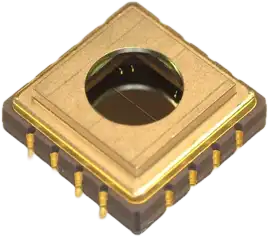
1.7 µm-class: one monolithic InGaAs die divided into four quadrants
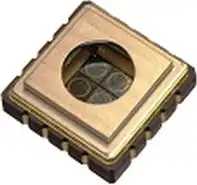
2.6 µm-class: four discrete extended-InGaAs detector elements in a 2 x 2 arrangement
LATHAM, NEW YORK – September, 2026 – Optrans America Corporation today announced an expanded portfolio of four-channel InGaAs PIN photodiodes for optical systems that require both infrared detection and positional information. The portfolio combines a 1.7 µm-class monolithic quadrant detector – one InGaAs die divided into four sensing segments – with a 2.6 µm-class configuration that arranges four discrete extended-InGaAs photodiode chips in a 2 x 2 square pattern.
Each configuration provides four separately readable detection channels, allowing system designers to compare incident optical power across the detector area and derive beam position, alignment, or movement.
Optical systems increasingly require more than a measurement of total light intensity. In beam-position and alignment systems, the relative signal from four detector regions can be used to determine horizontal and vertical displacement from the optical center, enabling precise centering, tracking and closed-loop optical control.
For longer-wavelength infrared systems, the 2.6 µm-class architecture extends the same four-channel detection concept beyond conventional 1.7 µm InGaAs by using four discrete extended-InGaAs elements in one compact package.
The 1.7 µm-class design uses a single InGaAs PIN photodiode die divided into four quadrants. Integrating the four sensing areas on one monolithic die supports compact optical position detection and closely matched four-channel measurements.
Representative devices in this family cover a sensitivity wavelength range of 600 nm to 1750 nm. Package formats include a TO-5 metal can and a 7.24 mm seam-welded surface-mount package, giving system designers options for optical instrumentation, industrial assemblies and high-density electronics.
The 2.6 µm-class configuration uses four discrete extended-InGaAs photodiode chips arranged in a square 2 x 2 geometry. The detector elements provide separate signal channels within a common package, enabling four-area comparison while extending detection into longer infrared wavelengths.
This architecture is intended for optical systems operating beyond the conventional 1.7 µm InGaAs range, including longer-wavelength beam monitoring, alignment and analytical instrumentation. Multiple compact surface-mount package formats are available.
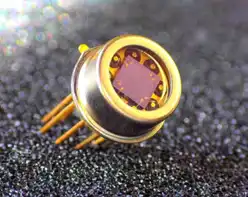
1.7 µm-class
TO-5 metal-can package
1.7 µm-class
seam-welded surface-mount package

2.6 µm-class
compact surface-mount package example
Across the portfolio, Optrans supports package configurations ranging from traditional TO-style metal cans to compact surface-mount formats. The examples below illustrate the range of mechanical integration options available for different optical and production requirements.
Custom packaging: Additional package and detector configurations can be evaluated based on customer optical, mechanical and electrical requirements.
Four-channel InGaAs detection is particularly useful when the optical system must determine not only how much light is received, but also where the beam is positioned. The 2.6 µm-class option further expands this concept into longer-wavelength infrared instrumentation.
| Feature | 1.7 µm-Class Quad | 2.6 µm-Class Four-Element |
|---|---|---|
| Detector architecture | Single InGaAs die divided into four quadrants | Four discrete extended-InGaAs chips arranged 2 x 2 |
| Signal channels | Four | Four |
| Wavelength class | Representative sensitivity: 600–1750 nm | Extended-InGaAs, 2.6 µm class |
| Package examples | TO-5 metal can; seam-welded SMD | Compact surface-mount configurations |
| Primary value | Monolithic four-quadrant position detection | Four-channel detection at longer infrared wavelengths |
Optrans America Corporation will continue to expand its InGaAs photodiode portfolio with additional detector sizes, wavelength ranges, package formats and customer-specific multi-element solutions. The company will also support application-specific detector and packaging configurations where technical requirements can be met.
By combining conventional 1.7 µm InGaAs technology with extended-InGaAs solutions reaching the 2.6 µm class, Optrans aims to provide optical system designers with greater flexibility in wavelength selection, position sensing and mechanical integration.
Optrans America Corporation
Latham, New York, USA
in**@************ca.com